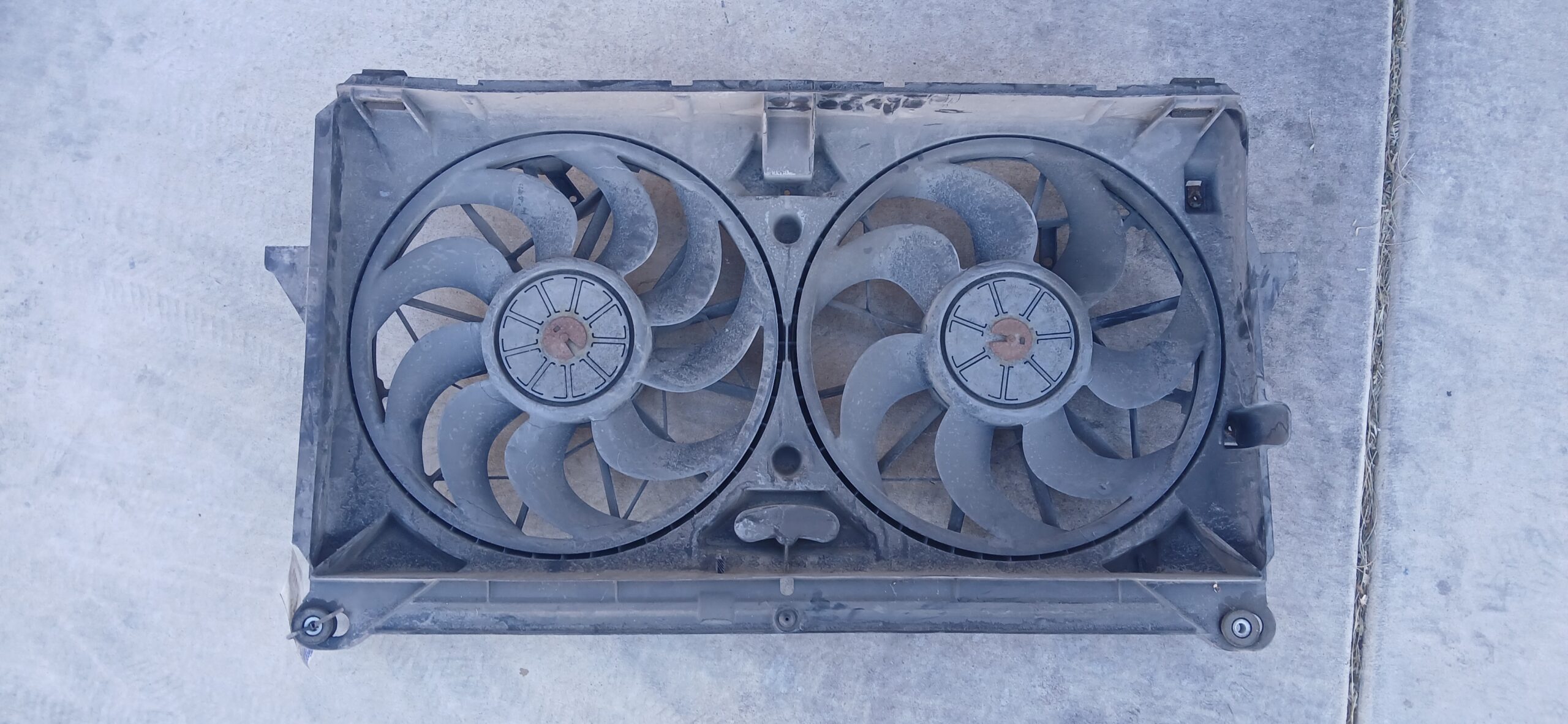
I grew up in the generation of plastic fantastic vehicles like the NBS 2nd Generation Chevy Tahoe. Despite their low quality interiors, they hold a certain nostalgia so I took on the project to restore a 2001 Z71 Chevy Tahoe, one of my dream trucks as a kid. I’ve had somewhat of an attachment to keeping the original mechanical clutch fan. However, after my about millionth tank of gas I’m growing less attached and have the feeling electric fans (efans) may improve mileage. Thus I’m taking on the project to upgrade my coolant fans from mechanical to electric. If you’re looking to do the same you’ve come to the right place!
First my build philosophy
My goal with the truck build was to improve on factory reliability, efficiency, and power. To maintain as purely mechanical and or simple of solutions as I could find. Specifically none of the displacement on demand, variable valve timing, or active fuel management stuff newer vehicles have which can be prone to failure.
I’d intended to keep a mechanical clutch fan. I love the simplicity of the design. They are also designed to reduce drag on the motor by decoupling the fan from the shaft on the water pump. This is accomplished through a fluid clutch where as temperature increases a fluid presses against a clutch transferring toque to the fan. It’s an elegant solution to engine cooling.
Unfortunately though, it’s hard to beat the efficiency of electric fans. After several years of low gas mileage (12 to 13 MPG), I’ve set out to see if I can improve on my gas mileage by using electric cooling fans.
Severe Duty Fan Clutch
A couple years back I discovered my factory original fan clutch was no good. With around 250,000 miles on the truck it was certainly overdue for a new clutch. If you are going to keep your mechanical fan you may like to consider a severe duty fan clutch. This increases torque to the fan, airflow as well as activates at a lower temperature. The clutch cooled like a dream. The truck NEVER overheated in any conditions even with AC on moving slow up mountains in 115F summer heat of desert. This is EXTREMELY demanding of cooling system.
I took a large hit in gas mileage around this time though. Went from 14 to 15 MPG city and 17 or better highway to 12 to 13 MPG across the board. Now, part of that was due to plugged catalectic converters. I restored the media in the cats with caustic soda (powder drain cleaner). Another topic for another day.
Electric Water Pump
I think this would be too far to take my build but is worth mentioning. Years ago I installed a Meziere electric water pump on my 1994 Z28 Camaro. It was worth every cent. This would be a good upgrade if you were say highway only. I go off road. I can trail fix a leaky pump or snapped belt but broken electric pump.
That aside, electric pumps are AWESOME. You can keep the pump running for a couple minutes after vehicle shuts down. They also free up horsepower much like the electric fans. If you have a tow vehicle or mainly drive highway it maybe worth looking into.
Best electric fans for GMT800

Fans purchased at junkyard from a GMT900 6.2L Escalade (2007 to 2014)
The next generation GMT900 truck fans are superior to the GMT800 electric fans. I am told any GMT900 fan assembly will directly bolt to the GMT800 radiator as they’re similar if not the same. The best fans are from the “Enhanced Cooling Package”. These are on the GMT900 Cadillac Escalades with 6.2L engine. There are a couple versions of that fan assembly. One has a 9 blade fan, and a 7 blade fan. That’s the one you want. The others have dual 7 blade fans. These also have 700 watt motors on them, they WILL require a upgraded harness (not the one from the GMT800. I melted my GMT800 harness with them. The 700 watt GMT900 fans will also require an upgraded alternator.
Here’s the 700 watt part numbers for the fan motors themselves if you want to upgrade and or rebuild a fan assembly:
- 700 watt right motor 15-81697
- 700 watt left motor 15-81696
If you purchase the GMT800 fans you can use the GMT800 harness with no issues as well as your existing GMT800 alternator.

Fans purchased at junkyard from a Cadillac with NorthStar engine
I went down a side path after visiting the junkyard. There I was told fans from a Cadillac NorthStar engine are a close fit and cool well. I bought a set for $40 then did a test fit when I got home. The entire fan assembly was both narrower and shorter than the radiator core. Would have been very tricky to mount.
Electrical Connections
Here’s where the wizardry starts to come into play. The P59 PCM from 3rd gen Small Block Chevy supports electric fans. However, you’ll need to pin the unpopulated fan control line. You’ll also need to wire up relay and fuse.
Some of the GMT800 trucks switched to electric fans in 2005. The harness from those trucks can be used to wire up these fans. I got help sourcing one (more info towards end of post).
The factory harness is likely 14 gauge if not 16 gauge leaving LITTLE headroom (excess capacity for increased power). It maybe prudent to upgrade wiring to the fans themselves with a higher gauge wire. I didn’t do this but if ever became an issue I’d consider 8 gauge GLX wiring.

Chart provides an idea of wire capacity for 12v electric system in vehicles. Different strand count and even temperature can impact these ratings.
I’m a bit confused by the 700 watt rating on the fans. The fuse blocks for these fans are populated with 40 amp fuse per fan. However, 700 watts at 14 volts is 50 amps. Not sure how they arrived at the 700 watt rating.
NOTE: I had to connect fan junction block power wire DIRECTLY to the battery. It was blowing fuses when powered off the junction block 12v posts.
High Speed Fan Hack
There’s two Digital IO pull down pins that control fan relay triggers. One DIO for low and second for high speed. Unfortunately, the system makes use of the high speed pin for the AC if your vehicle came from factory with a mechanical fan. Connector C2 Pin 33 on the PCM is for “Recirculation Actuator Control”.
Many people only connect pin C1 Pin 33 for the “Low Speed Fan Trigger” as a result. That works but you’ll have no high speed fans. My truck was overheating in desert summer (100F+) without use of high speed fans so I had to research this further.

I was able to maintain my AC function as well as re-pin C2 33 for the high speed fan trigger. The AC recirculation door still functions. It’s possible that pin commands the AC compressor clutch when the door is closed but I’ve yet to verify that.
High Speed and Low Speed trigger signals from PCM on vehicle equipped with electric fans.
Note C2 Pin 33 is already populated with a different function on trucks equipped with mechanical fans.

You can reconfigure C2 Pin 33 for high speed fan control in the tune. This involves changing Recirucation Fitted to “Fan #2” instead of ” AC Recirc.
Updating tune with fan settings
There are several parameters stored in the PCM for the fans. Depending on which fan assembly you bought you’ll want to swipe the corresponding settings from that base vehicle from which the fans were intended for.
There is a fan flow parameter in the Idle Airflow settings of HP Tuners. There I plugged in the values I swiped from a 6.2L GMT800 Escalade which I’d pulled my fan assembly from. Note the GMT800 fans flow less air so put the appropriate fan settings in there.

These are the fan settings I ended up using. I baselined my settings form a 2005 Chevy Tahoe with electric fans from the factory. Then adjusted them to my liking. I preferred the fans to turn on a bit earlier as I don’t like how the factory biases the engine a touch on the hot side.

Open Source Tuning
I utilized a license with HP Tuners to configure my fans. If you only populate the “Low Speed Fan” control C1 Pin 42 there’s a chance you may not have to program anything. Otherwise you have to reconfigure the AC to gain C2 Pin 33 “High Speed Fan” which requires tuning tools.
You can try open source tuning software such as TunerPro and a bidirectional scan tool such as OBDx. I’ve yet to experiment with these but may do the trick. Let me know if you try it.
AC fan control off clutch or toggle switch
I couldn’t get the PCM to control the efans when AC is requested. The trucks with older mechanical fan have “Analog Cycling” AC control system. The newer efan trucks use a “Serial Cycling” AC system with line pressure sensor instead of a switch. This tells the PCM pressure off the AC compressor. The mechanical system only has a discrete switch that triggers after threshold pressure is exceeded.
I digress, the short of this is, you cannot get the PCM to trigger the fans because the control loop won’t look at that pressure reading unless the PCM is configured as “Serial Cycling”. I tried to spoof the pressure signal with a voltage division circuit. The PCM did read it as a line pressure but it wouldn’t use it to trigger fans for AC. Unfortunately, if you configure as “Serial Cycling” then your “older “Analog Cycling” AC system won’t work at all.

You can modify the factory efan harness with a relay to turn on fans for AC
The gentleman who built my harness for me provided a relay to turn on the the high speed fan (C180 Pin A) using AC Clutch power. The trigger on the relay is connected to AC Clutch Power. This is a green wire on the middle black connector in the Under hood Junction Block. I should have more details but went a separate route. This is shown in Green in the above figure.
The AC system doesn’t demand the AC Clutch 100% of the time. Instead it works on a cycle to boost line pressure till threshold is reached and kicks off. Triggering the fans off the clutch power results in the fans cycling on and off with the clutch.
I instead wired a manual override switch to command the High Speed Fan on and placed it under my driver’s knee bluster in the cabin. I have to remember to turn on the fan when I switch the AC on. While not ideal it works for now. Forgetting to turn the fans on results in degraded AC performance. More specifically, only if the fans are not already on and I’m driving slowly.
In hindsight, the referenced configuration only turns on the right hand fan. I’ve found that a single fan in high speed doesn’t work as well as the both fans in low speed. Long story short, I’d preferred to have to AC switch control C180 B (command both fans on in low speed mode).
Additional thoughts
Using a GMT800 efan junction block and harness worked out out nicely. The only pitfall is seamless / automatic control of AC fan. You really want AC fan to be both high speed fans not low speed or one high speed fan. Additionally, sacrificing whatever I did to gain High Speed Fan control. Someday I’ll likely figure out what I lost reconfiguration that pin to “Fan 2”.
I spent a few weeks fiddling around designing a custom fan controller. Got software and basic circuitry to trigger fans off VSS (speed), ECT, and AC clutch. However, I couldn’t quite figure out how to tap in the ECT sensor signal. Everything else works except that and I really don’t want to add an additional sensor. Another approach I’d thought of would be to use the one wire datalink to request coolant temp, vehicle speed, and AC status. Unfortunately, no library was available to interface with the data bus. I’ve started to write one but not had much time to work on that either.
Thermostat Switch aftermarket fan setups often use a thermostat switch. This can be placed in the fins of the radiator. Two switches could command high and low speed. These alone could run the system. However, there would be no control for AC or vehicle speed.

If you short C180 A & B then the fans will always operate in high speed mode.
High Speed Only A simpler approach would be to splice A & B, green line in figure, so there’s no high or low speed, just high speed. Granted the high speed fans are noisy but this greatly simplifies the installation. Likely no need to reconfigure tune either. You can put your AC override relay in there too by connecting it to the splice.
Conclusion
I do miss my severe duty mechanical fan clutch, that noise it made when I hit the gas. It made pedestrians look twice before crossing the street. Almost sounded like a semi truck. It cooled like a dream, vehicle never once overheated.
I noticed no difference in throttle response going to efans. However, I got almost 2MPG improvement in fuel economy! You’d likely realize a bit less if you upgrade from a standard duty fan clutch. None the less hard to go back after that improvement!
As usual I spent way too much time on this and split too many hairs. There’s a post on Tahoe Yukon Forum linked HERE. The author sourced me a OEM harness; fully detailed and restored. I’d encourage looking him up if you plan on doing this. The post also has more details on this project.
Feel free to drop me a line if you have any questions converting your older mechanical fan system to efans.
UPDATE
I’ve been tuning the truck to run at a bit lower temperature. Specifically, I lowered the fan temp triggers and installing a 15F cooler t-stat. The result of this was the high speed fan wouldn’t kick off once up to temp. Mainly because I’ve exceeded the capacity of my radiator.
This caused COOL FAN RELAY 1 and COOL FAN RELAY 2 to overheat and fail. Upon further inspection the FAN RELAY was also failing and intermittent as only the high speed fan would spin (low speed did nothing). We ran through the circuit, control module, and fans. All else was fine.
It appears GM designed the high speed fan as a temporary mode not to be used for extended periods. I think having the high speed fans on all the time caused the relays to overheat.
I may need to revert to the 195F t-stat and factory fan trigger temps or install a larger radiator.

Damage to junction block

Melted relays FAN 1 and 2
