I built up a LQ9 (LS2) 6.0L engine for my 2001 Chevy Tahoe. I was built for off road use, slow driving over beautiful mountain trails in the Sonoran Desert. The heat here has pushed the factory cooling system to it’s maximum. I upgraded to eFans from 6.2L and proceeded to melt the relays as the high speed fan never shut off. It’s HOT which has presented a unique challenge the factory never accounted for. Here’s what I’ve done to keep my truck running cool.
Cooling System Specs
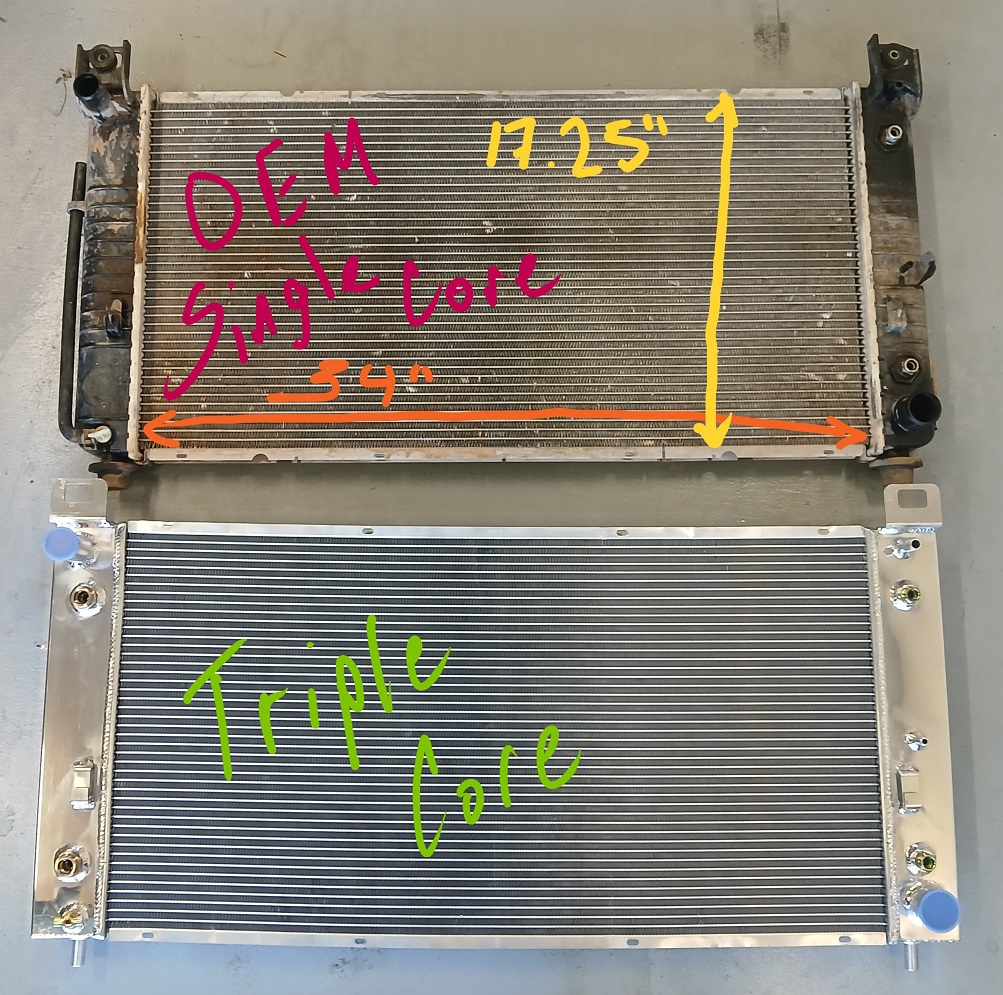
Triple Row Radiator: the factory radiator is a single row 1″ radiator. I purchased an aftermarket Frostbite FB288 (Holley Performance) triple row radiator. It’s 3″ thick, like having three radiator cores in one!
External Trans Cooler: I’m running a TruCool LPD47391. This cooler in hindsight is way too big. When run without a thermal bypass the ATF never gets to the operating temp for Dextron VI of 180F. I would scarcely get over 150F which is below the bottom range for the ATF.
ATF Thermal Bypass: the TruCool kit comes with a thermal bypass however, it’s not fail safe and can starve your transmission of fluid. I came across several people who’d had that happen online. I settled on a 180F Derale 3/8″ NPT Fluid Control Thermostat. It was excellent quality. Note I didn’t NOT use the barbed connectors bundled with it. I purchased AN6 fittings and bent my own metal hoses.
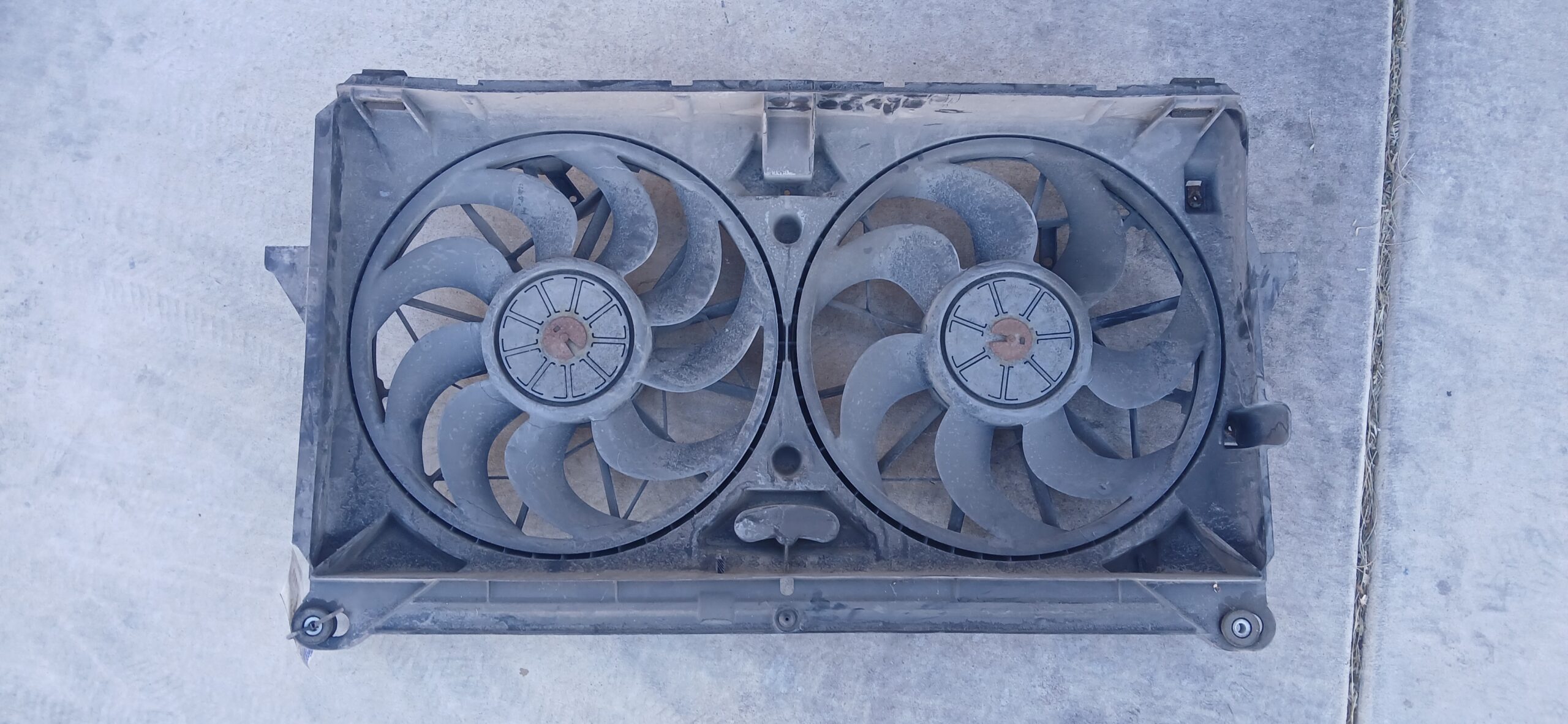
Electric Fan Conversion: I originally ran a severe duty clutch fan. That is the benchmark to beat in cooling. However, it sucked up nearly 2mpg so I switched to eFans. The fans are an ongoing project for which I have notes at this link, GMT800 efan Upgrade
NOTE: the liquid to liquid coolers inside the radiator are NOT for cooling. They sync ATF and oil temps with the coolant temp. Their main purpose is to get and maintain the oil temps within their ideal range. They heat up the ATF and or the engine oil on startup. Beyond ETC they are coolers. External coolers such as the liquid to air cooler for the transmission are for additional cooling if temps exceed ECT baseline for transmission.
Maintenance
Coolant: I have been running Ethaline Glycol (universal) coolant mixed 35/65 to distilled water.
I ran a higher ratio of water to try and absorb more heat from the engine. Water absorbs heat better than the coolant. Water is also more viscus so puts less drag on the pump. You shouldn’t run straight water though as the coolant has anti corrosion additives, lubricant for the pump, as well as it resists fluid expansion unlike water which can break your engine if it freezes.
Thermostats: I’ve run a 195F, 180F, and now a 160F. These were all MotorRad brand t-stats. I don’t believe 160F is advantageous. It was simply to see if I could squeeze some more performance out of the radiator on the trail (wasn’t the case).
ATF: currently running Dextron VI. A friend suggested I try a different ATF which is superior in almost every aspect to Dextron VI as as as compatible. It’s Mobil 1 Synthetic LV ATF HP. I’m goin to try it next time I service the transmission.
Surge tank return line (modification)

This shows the surge tank with an unrestricted radiator surge tank line from the aftermarket radiator I installed (upper right photo). You can see the coolant (orange fluid) flowing in the baffle for the radiator surge tank line.
This was my initial thought to improve cooling with the factory radiator. In hindsight, I’m not sure it would have done much to help my factory radiator as the radiator temp was slightly if any below the engine coolant temp. That aside it would be preferred to have an unrestricted radiator surge line as you can configure to be restricted or open.
This port on the radiator allows steam and air pockets to vent into the surge tank. There they condense back into liquid. The larger submerged hose on the surge tank flows directly into the engine block, effectively bypassing the thermostat. Thus any fluid that enters the surge tank isn’t subject to the thermostat.
There is a hack a couple friends have tried that is to remove the restriction in the radiator on the surge tank line. It can reduce the overall temperature your coolant system settles out at by flowing coolant from radiator directly into engine block. However, it can also make it difficult to get the coolant up to operating temp if the ambient environment is too cold because it defeats the thermostat (with a small portion of the coolant).
I’m not sure this would have much helped my scenario as the factory radiator is nearly the same temp as the coolant flowing through it. Effectively the factory radiator was maxed out.
Installing a triple row radiator

I purchased a Holley, Frostbite, triple row radiator. It was simple to install. Aside from the fan shroud. They should have appropriately offset the mounts on the radiator to accommodate the fan shroud. Instead the radiator as is, interferes with the fan and the shroud has to be trimmed along the top and bottom.

You have to trim the bottom lip almost completely off (bottom right photo). Otherwise it won’t sit in the hangers on the radiator. The upper fan shroud has to be considerably trimmed as well. I trimmed mine down to nearly 3/4″ There is ample room within the core support with the triple row radiator installed so it’s tacky to say the least that Holley didn’t account for this in the design.
Notes on Frostbite radiator
I believe this is a private label of the same Chinesium triple row radiators for sale all over eBay. Despite this the radiator appears to be well made. I cannot say the same for the included hardware. The radiator grommets fell apart so I had to reuse my original ones. It would have been nice if the oil cooler came plugs and quick connect fittings as they don’t offer an option w/o the oil cooler. That aside, I purchased Holley as apposed to generic knowing that to get some sort of warranty.
It would be nice if there was a factory radiator that was double core / double row. The cooling system on the factory design with the single row radiator leaves very little headroom for cooling and in my case virtually none. There are also no larger options from the factory to fit the GMT800 than what I already had.
I did look into a Cold Case double row radiator. The Cold Case is the same price and includes a 3rd row so is bigger. However, the Cold Case radiator came with a lifetime warranty. Both have the same fitment issues. Despite this I’d preferred the Cold Case, a friend bought one too for his build. However, when I contacted Cold Case sales team they didn’t give me much confidence their radiator could meet my cooling requirements.
Triple Row Radiator Testing

When purging the coolant I took measurements of the radiator and fill line. The coolant coming out of the block was at a minimum 166F. This makes since as I tested it with a 160F thermostat. The radiator sat between 130 and 140F while idling with the coolant fans off. I should have but didn’t save pictures of the factory radiator which was hotter. It ran at 190F to 200F while idling, with the 160F t-stat. The triple row when idling without a load never gets over 140F, whereas the factory radiator always did.
Test Course

Highway driving is a none issue. Over 50MPH creates enough airflow to cool the radiator as well as the coolant. The factory radiator would get in the 170F range with a 160F t-stat and 100F ambient temp.
City at 30 mph is on the cusp of needing more cooling in 100F ambient temps. There’s little of no traffic where I live so the better place to test low speed trail and city driving is in the mountains. It’s my feeling if the truck can handle the mountains then it can handle city traffic.
I established a test track on a mountain trail that goes to service some TV antenna on a peak HERE. Over the past couple months I’ve been testing different configurations to see if I can get the truck to run cooler. Below we’ll test the factory versus triple row radiator with 160F t-stat in 100F ambient temps.
Ideally I’d like to settle out between 180F and 190F on the trail. This is not the ideal cruising temp, which would actually be much higher. However, the engine seems to like this temperature and leaves plenty of headroom for when I have to push the truck even harder.
NOTE: I even tried driving FASTER on the test track to get airflow over radiator but made things even hotter employing the high speed fan. Neither test made use of the air conditioning.
Factory versus triple row on mountain trail (test track)

I forgot to save pictures of the inlet and radiator temps on the test run for the factory radiator. They were both around 200F, approximately 30F hotter.
Reference lines in charts below as follows: ATF temp dashed red line is 180F. ETC dashed green line is 200F. IAT dashed yellow line is 100F.


The data logs show little if any difference between the factory radiator and the triple row radiator. The only marked difference was the temperature of the radiator itself. The triple row seems to have unutilized cooling capacity.
Air intake heat soak
It appears at slow speed the air intake is getting heat soaked. I have a separate post on the Banks Cold Air Intake. The factory intake design is superior to the Banks cold air intake under most all conditions except wide open throttle. I cover this in a separate post. Hot air seems to be getting into the intake track due to the Banks CAI airbox not sealing up with the fender like the factory design does.
Current thoughts
Disclaimer; I am not an expert, although, I do know more than your average keyboard jockey. The goal of my build has always been to try and improve on the factory design which is easier said than done.
The factory radiator seems to be adequate. It’s been optimized for a wide range of environments. Trying to climb mountain roads in 100F heat doesn’t seem to be well optimized by factory. Having reconfigured factory spec with a triple row radiator may now create issue at the low end of temperature range. Someday I hope to visit the far north where I may struggle with this larger radiator.
My goals has been to get 180 to 190F ECT, with 190F to 200F ATF temps for trail use. Those temps continue to elude me. The triple row radiator seems to have more cooling capacity than the factory radiator as measured. However, the impact on ATF and ECT as tested was not measurable. Likely I’m against the limit for my cooling fans or something else.
ATF is very hard to heat up. It never really reaches ECT despite the liquid to liquid cooler acting on it. Thus the liquid to air cooler (TruCool) is oversized. The thermal bypass in theory is always closed as temp never reaches it’s open temperature of 180F.
I have noticed through experience, once ATF temp get’s too hot it easily runs away so the external cooler is a big help as well as the thermal bypass. Before I had the thermal bypass installed it was impossible to get trans temps much up over 150F, most of time the gauge barely broke 100F.
Cooling Fans:
These ultimately seem to dictate what temperature the fluid gets to on my test track. I hate relying on the low speed fan, and certainly don’t want to rely on the high speed fan for anything more than short bursts. However, it maybe the low speed fan has to be on for the duration of trail runs.
The underlying motivation for fan triggers would be used to constrain fluid temps to healthy, and efficient ranges of operation. 180 to 200F for ATF. ETC closer to 180F, no more than 200F. The factory seems to favor hotter ECT likely for reasons of emissions and less so for reliability and not necessarily for efficiency either. Likely hotter than 180F ECT is more favorable for efficiency but at a cost to reliability. Perhaps as high as 215F ECT would lend to higher MPG. Hence the factory has a 195F t-stat with fan temps set to contain ECT in the 200+F range.
Ideally, none of the fans would be utilized at the radiators steady state temp when ample airflow is present from highway driving. The steady state temp seemed to be around 180F to 190F with factory radiator in 100F ambient temps when cruising anywhere from 50 to 80 MPH.
I’d think the fans should be calibrated for some use in city driving. City ECT temps would be the lower trigger for the low speed fan temps. Then the high speed fan temps would serve as a protective measure against thermal runaway or over temp, I like to think that’s somewhere around 225F so a trigger somewhere below that.
On another note, I’m not sure if the PCM can turn off the fans for AC use while on the highway. The airflow would be more than ample to cool the condenser without any fans.
Seems I have more work cut out for me…